
The Israeli military acknowledged that its troops shot at Palestinians, in the third such instance in three days. Plus, US man charged for framing immigrant in fake plot to kill Trump
 October Surprise 2016 - octobersurprise2016.org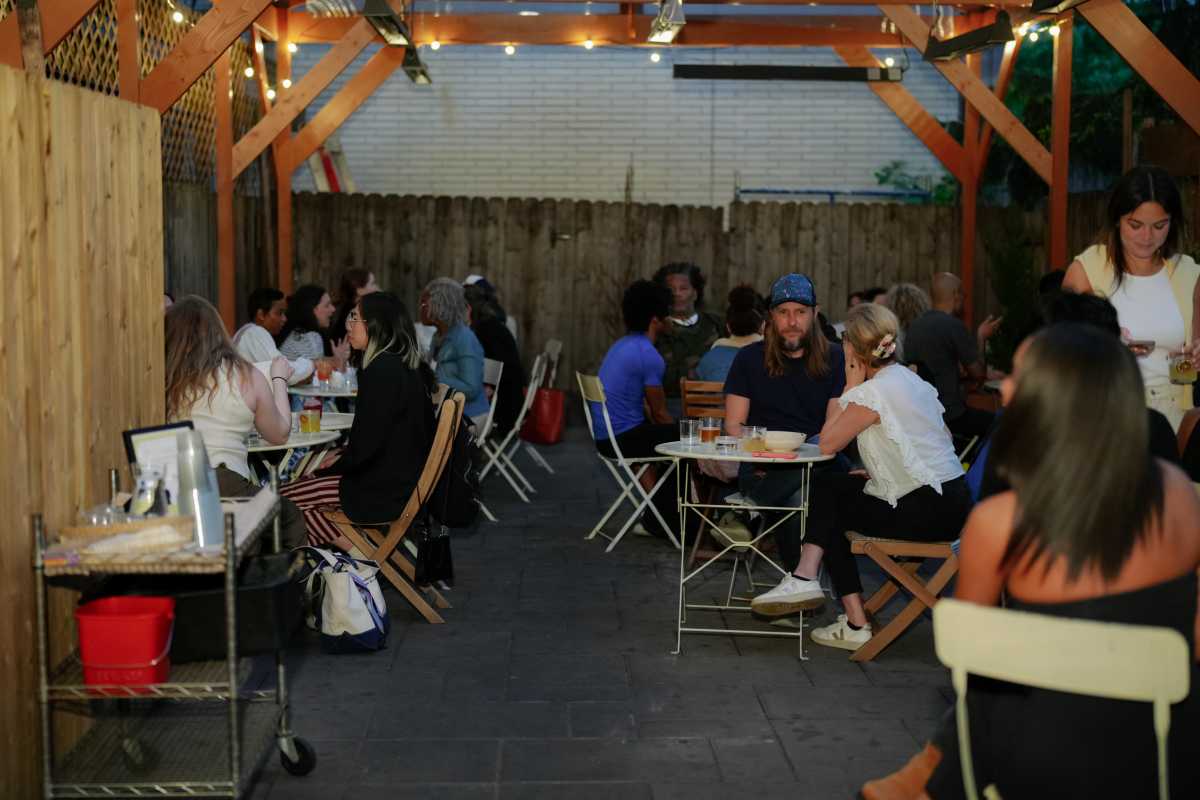
A local bar and cafe in Brooklyn recently celebrated one year in business at its new location in Fort Greene.
baba cool, located at 33 Lafayette Ave., didn’t always call this current location home. When the restaurant first started in 2014, it was not too far from where it is now, just in a smaller space.
Gabriella Mann, owner of baba cool, quickly fell in love with the neighborhood and worked to make baba cool a Fort Greene staple.
“We kind of created a really nice community within Fort Greene during that 10-year period. We made it through COVID and kind of grew during that time, just because I stayed open the entire time. We started feeding the hospitals and that was like a whole community effort,” said Mann.
A year ago, baba cool moved into its current space on Lafayette Avenue, boasting an indoor and outdoor space for expanded seating, particularly as the weather gets warmer out. The outdoor dining area is also completely covered, in case a rare summer shower blows through and providing shade to diners.
The original baba cool started off serving classic cafe options, such as avocado toast, breakfast sandwiches, specialty coffees and the like. As the customer base continued to grow and with the restaurant being near cultural institutions like Barclays Center and BAM, Mann wanted to expand the concept to include a nighttime menu.
“Fort Greene was changing, and over the years, I’ve made a lot of friends, and I see a lot of the same faces still to this day, and it’s been nice to kind of expand the original concept into something that’s open at night and lends itself to like all the different arts and cultural things happening around us,” said Mann.
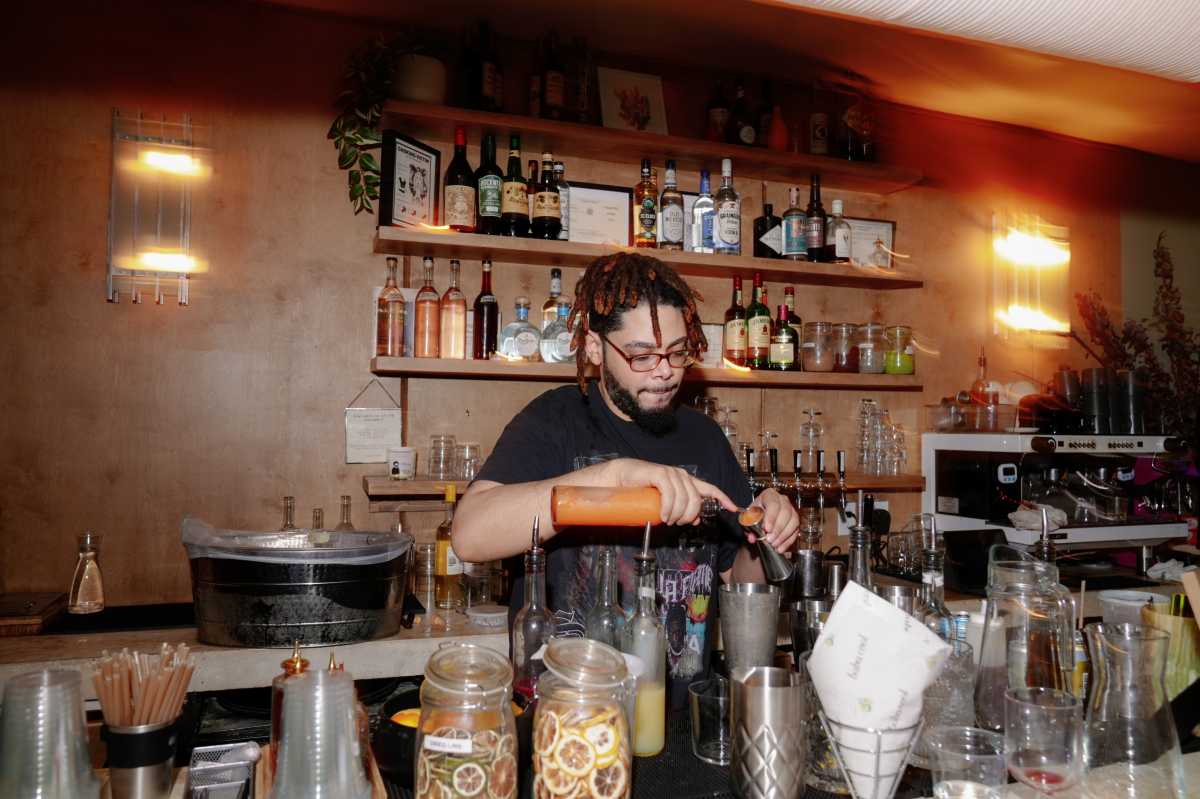
In addition to the space’s morning menu for the early birds, the menu offerings expanded to include a lineup fit for an evening crowd. Mann partnered with lead bartender Michael Seward to create a selection of unique cocktails, including options such as the Cowboy Poser (a rum-based beet cocktail), the Baba Martini, and A Very Good Cocktail (featuring vodka, aveze, tarragon, anise, lime, bitters and bubbles). The bar also features a Revolving Pour, which is the bartender’s choice alcohol and bubbles, as well as a menu of wine, beer and mocktails.
The night food menu features options such as Brussels Sprouts, Baba Fries served with manchego, scallions and cayenne mayo, Crispy Chicken, Whipped Ricotta with fennel seed, bee pollen, honey and toast, and shrimp toast. A particularly popular dish is the Drunken Gabi, which serves rice noodles served along broccolini and cabbage in a green goddess dressing.
“We still wanted to keep it casual and not fussy and still play with the idea of what we do during the day, which is just simple, really delicious, approachable food. Nothing too crazy, something I think that people just come back for and can eat every day,” said Mann.
Since the reopening, Mann says that the new space has been well-received by their customer base, as they can now sit and chill out.
“We moved a little farther south, but we definitely still see some of the same faces and I think people are just like thrilled that they have actually a little space to hang out and sit in and have coffee or wine, whereas in our old 300-square-foot space, it was always cramped and people couldn’t find a seat, and people are ending up taking things to go, even though they wanted to stay. Now people can actually sit, stay, and enjoy,” said Mann.
For more information, visit babacoolbk.com.

The post Fort Greene’s baba cool celebrates one year in larger location with outdoor dining space first appeared on The Ocean Avenue News – oceanavenuenews.com.
The post Fort Greene’s baba cool celebrates one year in larger location with outdoor dining space first appeared on The Brooklyn Times – bklyntimes.com.
#Colorado #Boulder #Crime
Start your day with “Morning in America,” NewsNation’s live three-hour national morning newscast hosted by Markie Martin. Weekdays starting at 6a/5C. #MorningInAmerica
NewsNation is your source for fact-based, unbiased news for all Americans.
More from NewsNation: https://www.newsnationnow.com/
Get our app: https://trib.al/TBXgYpp
Find us on cable: https://trib.al/YDOpGyG
How to watch on TV or streaming: https://trib.al/Vu0Ikij

The Istanbul negotiations between Ukraine and Russia, held in March 2022, initially raised cautious optimism about the possibility of a diplomatic resolution to the war. However, they ultimately failed to produce lasting results. This failure was not due to a lack of Ukrainian willingness to engage, but rather to Moscow’s systematic strategy to manipulate, stall, and ultimately undermine the process.
More on this story: Beyond Istanbul: Strategic Steps for the Coalition if Putin Refuses Engagement

2. Background: The Istanbul Talks and Their Framework
The negotiations in Istanbul were part of a broader series of peace efforts following Russia’s full-scale invasion of Ukraine in February 2022. At the time, Ukrainian forces had successfully repelled Russian advances on Kyiv, creating a window for talks. The Ukrainian delegation offered a framework of neutrality and security guarantees in exchange for the withdrawal of Russian forces and restoration of territorial integrity.
Despite some signs of convergence, such as Moscow’s formal acknowledgment of Ukraine’s willingness to remain non-aligned, the talks stalled. Soon after, Russia intensified its military operations in the Donbas and launched further assaults on civilian infrastructure.
3. Russia’s Strategy: Negotiating in Bad Faith
Russia entered the negotiations not to reach a settlement but to buy time, regroup militarily, and test Western unity. Key elements of this strategy include:
The Kremlin’s core objective remained unchanged: to subjugate Ukraine and ensure it remains within Russia’s sphere of influence. A genuine peace that respected Ukrainian sovereignty would contradict Putin’s imperial ambitions.
4. Why Russia Undermines Peace Initiatives
The Kremlin undermines peace negotiations for several reasons:
5. The Role of Sanctions and Their Potential Impact
Economic sanctions have damaged the Russian economy, but their political effectiveness is mixed:
Ultimately, while sanctions are not a silver bullet, they remain a key tool to constrain Russia’s capacity to sustain the war and pressure it back to the negotiating table—this time under different terms.
6. What Can Be Done: Strategic Recommendations
7. Comparative Cases
Russia’s behavior in the Istanbul negotiations is not unique. Similar patterns are evident in:
Each case demonstrates Moscow’s preference for negotiation as warfare by other means—tools for achieving strategic goals, not peace.
The Istanbul negotiations failed because Russia never intended for them to succeed. For the Kremlin, talks are tactical pauses, not paths to peace. This behavior reflects a broader pattern of strategic deception and refusal to recognize neighboring countries as truly sovereign. The international community must draw the right conclusions: only sustained pressure—military, economic, and political—can bring about a meaningful diplomatic opening. Sanctions are part of that equation, but they must be part of a comprehensive strategy that understands the true nature of the Kremlin’s war.
The Kremlin does not genuinely respect the White House in strategic terms. Instead, it views the United States as both its main geopolitical rival and the primary obstacle to Russia’s ambitions for global influence. From Moscow’s perspective, undermining U.S. authority and credibility—especially in the realm of international security—is central to its foreign policy.
1. The Kremlin’s Strategic Goal: Undermine U.S. Global Leadership
Vladimir Putin and his inner circle do not seek cooperation with Washington unless it benefits Moscow directly. Their priority is to challenge and discredit U.S. influence, particularly by:
2. Discrediting Washington on the Global Stage
Russia constantly seeks to demonstrate that the U.S.:
Kremlin-backed media and diplomats amplify every U.S. failure—be it Afghanistan’s withdrawal or difficulties in Ukraine—as “proof” that the U.S. is no longer a reliable security actor.
3. Russia’s Tactic: Strategic Mockery + Engagement When Useful
While Moscow may sometimes engage diplomatically with the U.S., it does so only tactically:
But even during talks (like START treaties or Syria deconfliction lines), Russia often:
4. Ultimate Objective: Multipolar World Without U.S. Dominance
Putin envisions a world where the U.S. no longer sets the global rules. His policy is to accelerate U.S. decline, especially by:
The Kremlin does not respect the White House in the traditional diplomatic sense. It sees Washington as a declining hegemon whose global leadership must be discredited, bypassed, or broken. Any cooperation is tactical and transactional. The Kremlin’s strategic narrative hinges on showing that the U.S. can no longer shape global security outcomes, and that Russia (often with China) is a rising alternative.
In the current conditions—where the Kremlin does not respect the United States and is actively working to discredit it—the U.S. cannot “force” Russia to peace in the traditional sense. However, the U.S. can shape the environment in such a way that continuing the war becomes too costly and strategically unsustainable for Russia. Forcing peace in this context means altering Russia’s cost-benefit calculation, not convincing the Kremlin morally or diplomatically.

Why the U.S. Cannot Simply Force Russia to Peace
What the U.S. Can Do to Alter Russia’s Calculations
1. Escalate the Costs of War
2. Target Russian Assets and Power Centers
3. Strengthen the Global Narrative
4. Build and Demonstrate Long-Term Western Resolve
Could the U.S. eventually force peace?
Only indirectly—by making it strategically impossible for Russia to continue the war without risking regime collapse or unacceptable military defeat. This requires:
The post The Istanbul Negotiations: Russia’s Strategy of Undermining Peace Talks and the Limits of Diplomacy first appeared on JOSSICA – jossica.com.
The post The Istanbul Negotiations: Russia’s Strategy of Undermining Peace Talks and the Limits of Diplomacy first appeared on The World Web Times – worldwebtimes.com.
The mission was planned for over a year! Why does anyone except Ukraine have a say in its execution? They used conventional drones and semis to carry out the mission. No EU or American weapons were involved!
— gsalisb (@gsalisb) June 3, 2025
The post @Bannons_WarRoom @JackPosobiec The mission was planned for over a year! Why does anyone except Ukraine have a say in its execution? They used conventional drones and semis to carry out the mission. No EU or American weapons were involved! first appeared on The Russian World – russianworld.net.
The post @Bannons_WarRoom @JackPosobiec The mission was planned for over a year! Why does anyone except Ukraine have a say in its execution? They used conventional drones and semis to carry out the mission. No EU or American weapons were involved! first appeared on The World Web Times – worldwebtimes.com.
The post @OSINT_MB Revoltant, ils nous narguent littéralement first appeared on JOSSICA – jossica.com.
The post @OSINT_MB Revoltant, ils nous narguent littéralement first appeared on The World Web Times – worldwebtimes.com.

The post @LukasLhotan Na fotce je nákladní vlak ty proruský trole first appeared on JOSSICA – jossica.com.
The post @LukasLhotan Na fotce je nákladní vlak ty proruský trole 🤣 first appeared on The World Web Times – worldwebtimes.com.